Published April 25, 2024
Updated April 16, 2026
Cruise Industry Present Day & Forecast
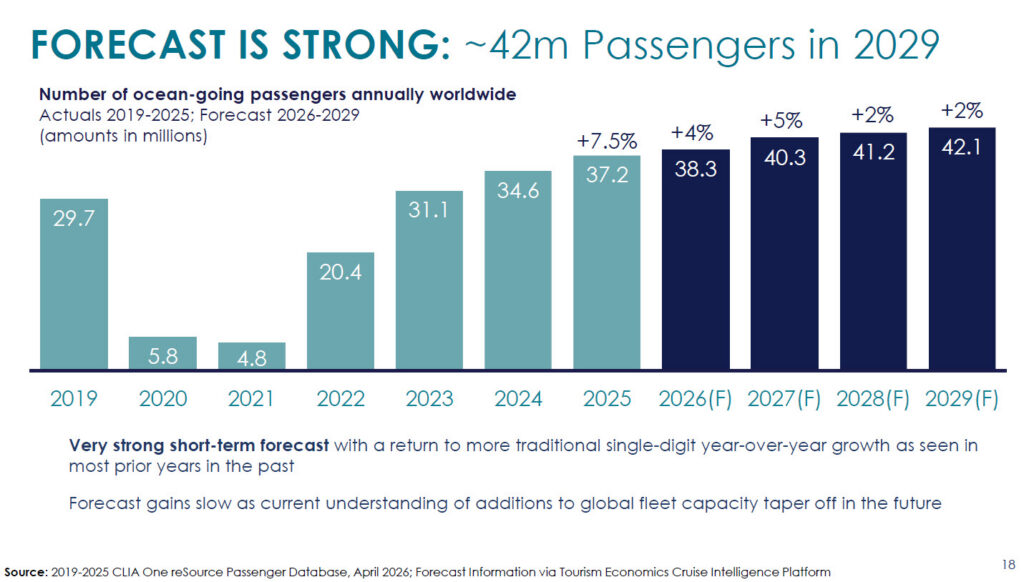
Cruise tourism continues to be one of the strongest and resilient sectors of travel! With 37.2 million passengers having sailed in 2025 and 38.3 million expected to sail in 2026 (CLIA), there’s no denying that the future of cruising is bright.
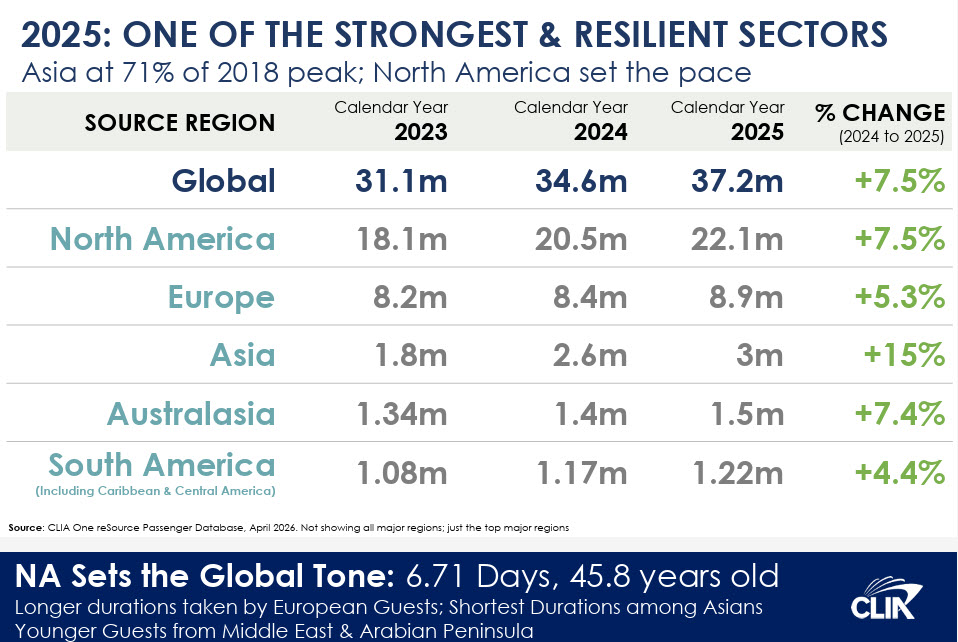
Cruise Industry Overview Quick Facts (CLIA):
- 37.2 million cruise passengers sailed in 2025
- 38.3 million cruises passengers expected to sail in 2026 (21.7 million are expected to be American)
- Global passenger volume expected 42.1 million in 2029
- 81 new cruise ships on order between now and 2036
- The cruise industry is expected to reach $35.8B by 2027
- 63% of cruise passengers book through a travel agent
- 73% of cruise travelers say travel advisors have a meaningful impact on their decision to cruise
- 90% of travelers who have cruised before say they will cruise again
- 28% of those who cruise take 2+ cruises a year
- 50% of cruisers drove to their embarkation port
- 75% of the U.S. population is within driving distance of a cruise port
- 31% of cruisers over the past two years are new-to-cruise (an increase of 12%)
- 33% of cruisers sailed in pairs; 7% sailed solo
- 75% of cruisers sales in parties with 1 or 2 generations
- 70% of cruisers go on a shore excursion
- Passengers sailing on expedition itineraries has increased 71% from 2019-2023
- Millennials are the most enthusiastic about planning a cruise holiday
- North America remains the largest cruise market
- Caribbean remains the top destination for cruisers
- Average age of a cruiser is 46 years old
Cruise Industry Investment
The cruise industry is investing over $70 billion dollars towards driving innovation and transformations over the next decade. In pursuit of a more responsible, efficient, inclusive, and enjoyable vacation experience, cruise lines are investing in LNG-powered ships, eco-friendly cruise travel, enhanced use of technology onboard, more onboard entertainment and activities, multi-generational experiences, and much more!
New Ships

One of the main areas that cruise lines have, and will continue to, invest heavily in is their ships! A fleet of brand-new cruise ships will set sail, bringing with them a wave of excitement, relaxation, and unforgettable experiences. Cruisers will have the opportunity to immerse themselves in a world of advanced technology and unparalleled comfort, indulging in luxury as they soak up the local culture, or embark on thrilling adventures.
Private Islands
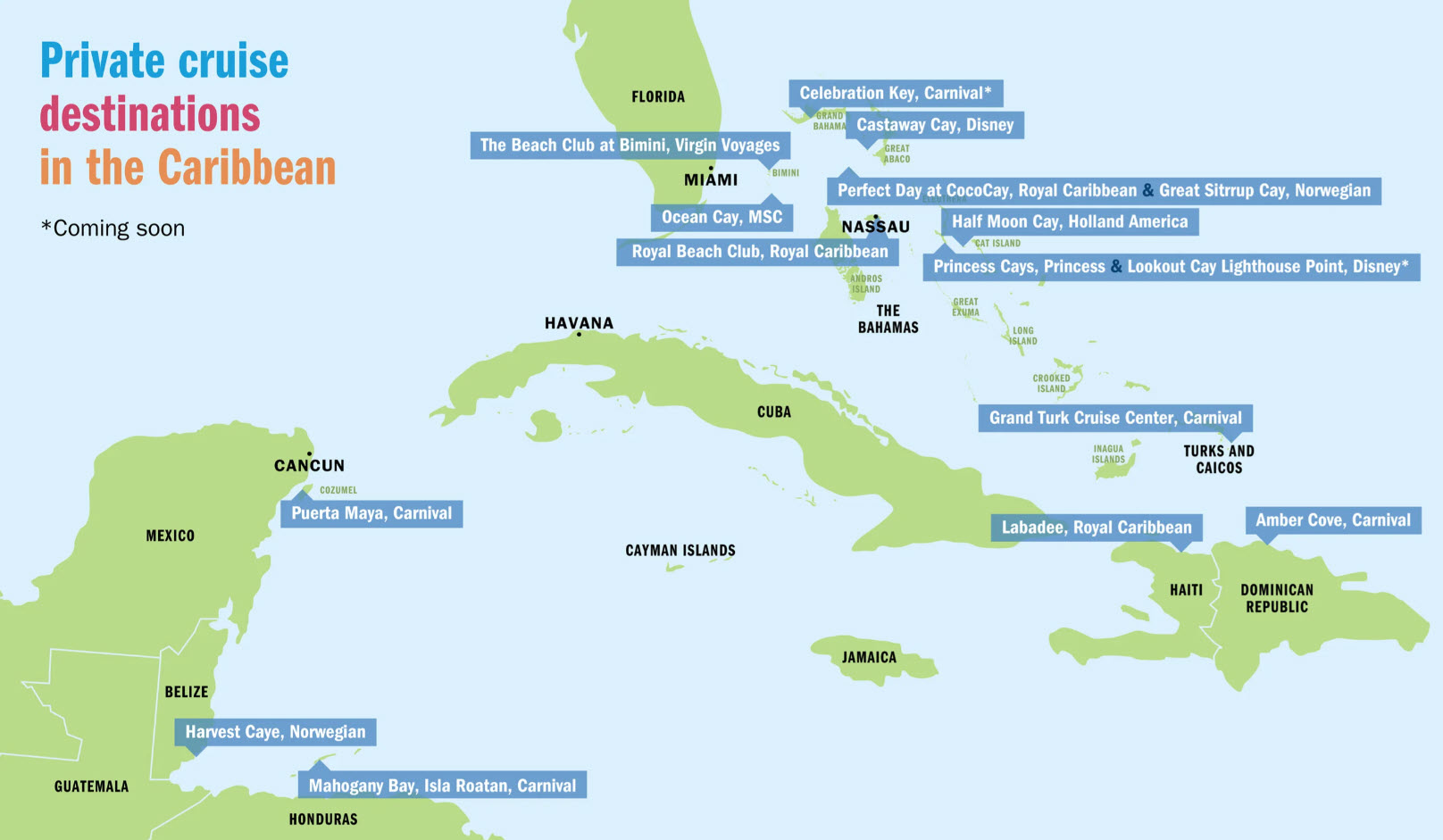
The private islands of cruise lines have always been some of the top destinations for travelers sailing to the Caribbean or Panama Canal. These exclusive retreats have something for everyone, from eco-tours and water excursions to theme park thrills and beach side lounging. With the rise of popularity of these private islands, cruise lines have invested billions of dollars into enhancing and expanding their private islands; creating over-the-top experiences to all those who visit. Here are a few cruise lines and their private islands (plus, 5 new private islands and beach clubs opening in the next two years):
- Azamara Club Cruises – Labadee, Haiti
- Carnival Cruise Line – Amber Cover, Dominican Republic / Mahogany Bay, Isla Roatan / Puerta Maya, Cozumel / Princess Cays, Bahamas / Half Moon Cay, Bahamas / Grand Turk Cruise Center, Turks and Caicos / Celebration Key, Grand Bahama
- Disney Cruise Line – Castaway Cay, Bahamas / Lookout Cay Lighthouse Point, Bahamas
- Holland America Line – Half Moon Cay, Bahamas
- MSC Cruises – Ocean Cay, Bahamas
- Norwegian Cruise Line – Great Stirrup Cay, Bahamas / Harvest Caye, Belize
- Princess Cruises – Princess Cays, Bahamas
- Regent Seven Seas Cruises, Oceania Cruises – Harvest Caye / Great Stirrup Cay, Bahamas
- Royal Caribbean International – Perfect Day at CocoCay, Bahamas / Royal Beach Club, Nassau / Labadee, Haiti
- Virgin Voyages – The Beach Club at Bimini
New Ports/Port Enhancements
Is there a better sign of a booming cruise industry than cruise lines adding/enhancing their embarkation and disembarkation ports? Royal Caribbean Group is a great example of how cruise lines are investing in the future by partnering with large infrastructure companies to withstand the volume of cruise passengers expected in the next few years.
“Our partnership with iCON is a unique opportunity to catapult us into the coming decades of port investments, build further financial strength, and provide exceptional cruising experiences, responsibility, to our guests at the best destinations in the world” – Jason Liberty, President and CEO of Royal Caribbean Group (cruisehive)
Several other cruise lines including, Carnival Corporation, Virgin Voyages, MSC Cruises, and Norwegian Cruise Line have invested, or are committed to invest, hundreds of millions of dollars in the coming years to enhance their port presence.
Industry Trends
Each year new trends emerge in the cruising industry that pave the way for the future of cruising. In 2019, we saw an increased demand for off the beaten path destinations, tech-driven features on ships, and an increase in working nomads – to name a few. 2023 trends included a focus on sustainable and responsible tourism, the use of tech onboard, and longer and more luxurious cruises for the seasoned travelers, and shorter cruises for first timers. Fast forward to 2026, cruising trends today include private island expansions, growth of river cruising, younger generations being the future of cruise, continued popularity of expedition cruising, quick escape cruises and multi-generational traveling.
River Cruising

River cruising continues to surge in popularity as travelers look for more immersive, culturally rich ways to explore the world. The global river cruise market is expected to grow by more than $3.4 billion between 2024 and 2029, reflecting strong demand for smaller-ship experiences that combine comfort with destination-focused travel (Technavio).
Unlike traditional ocean cruising, river cruises sail directly through the heart of historic cities and scenic regions—from the Danube and Rhine to the Nile, Mekong, and Mississippi—allowing travelers to experience multiple destinations with minimal transit time. This appeal is helping drive long-term growth, with the river cruise market projected to expand at approximately 11% annually through 2036, one of the fastest growth rates across cruise segments (Future Market Insights).
Investment from major cruise brands is further accelerating momentum. Cruise lines are expanding fleets, launching new ships, and introducing itineraries in emerging regions, while advance bookings and capacity growth continue to rise across the sector (Seatrade Cruise News; Reuters).
As travelers increasingly prioritize slower-paced journeys, boutique-style ships, and deeper cultural engagement, river cruising is becoming one of the most attractive options for luxury and experience-driven travelers in 2026 and beyond.
Expedition Cruising
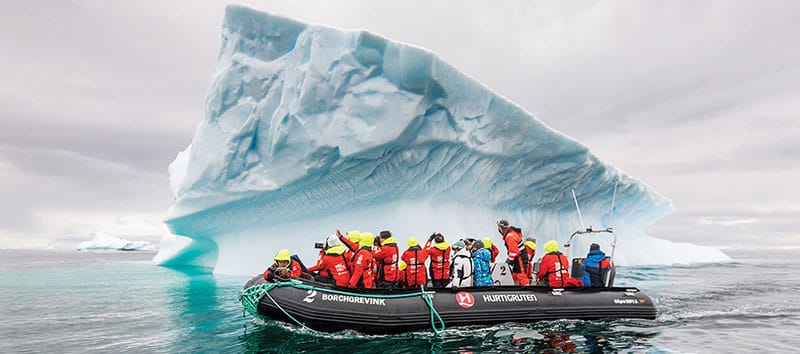
Who says you can’t have adventure and luxury? Small-ship expedition cruising is one of the fastest-growing segments in travel, with the number of passengers sailing on expedition itineraries increasing 71% between 2019 and 2023 (CLIA). Even more recently, expedition and exploration cruises saw an additional 22% passenger increase from 2023 to 2024 alone, making them the fastest-growing segment of the cruise industry today (CLIA 2025 State of the Industry Report).
Although these cruises come with a higher price tag, demand continues to surge as travelers increasingly prioritize immersive, once-in-a-lifetime experiences over traditional sightseeing vacations. From the Arctic and Antarctica to the Galápagos Islands and remote regions of Africa and the South Pacific, expedition cruising combines eco-discovery, cultural enrichment, and expert-led exploration with boutique luxury accommodations and personalized service. Capacity in the expedition cruise segment is also expected to grow by approximately 150% between 2019 and 2029, reflecting strong long-term confidence from cruise lines investing in new purpose-built ships (Cruise Industry News / CLIA).
This shift is being driven in part by affluent travelers seeking “bucket-list” destinations and younger demographics entering the luxury adventure market, with expedition travel now representing one of the most desirable ways to explore remote parts of the world. Seabourn, Viking, Silversea, Hurtigruten, Scenic Luxury Cruises & Tours, Ponant, and Aurora Expeditions are just a few of the cruise lines expanding their expedition offerings to meet this growing demand.
Multi-Generational Traveling

Cruising continues to be one of the most popular vacation choices for multi-generational families, offering something for every age group in one seamless experience. According to the Cruise Lines International Association (CLIA), nearly one-third of cruise guests now travel with three or more generations, highlighting how strongly cruises appeal to extended families travelling together.
This growing popularity is driven by several key advantages: the variety and abundance of dining options to suit different tastes, entertainment and activities for all ages, flexible shore excursions, family-friendly stateroom configurations, and the convenience of unpacking once while visiting multiple destinations. With global cruise passenger volume reaching 37.2 million travelers in 2025, cruising continues to set new records and attract families looking for easy, value-packed vacations.
As more Millennials and Gen-X parents travel with both children and grandparents—and introduce first-time cruisers to the experience—multi-generational cruising is expected to remain one of the strongest drivers of cruise industry growth through 2026 and beyond.
Environmental Sustainability
With a goal of net carbon neutral cruising by 2050, cruise lines are pursing innovative solutions, and investing billions, into sustainable cruising. But what exactly does this mean? For starters, almost all cruise lines are opting to use LNG for all new ships being built in the future. Liquified Natural Gas (LNG) are natural gasses that are drawn from the earth’s core and then are super cooled to become liquified natural gas. This liquified state makes the gas odorless, colorless, non-toxic, and non-corrosive. The advantages of adopting LNG are impressive as it creates a cheaper, more efficient, and more environmentally friendly gas. LNG releases zero sulfur, has 99% less particulate emissions, 85% less nitrogen oxide emissions, and 25% less greenhouse gas emissions. Using LNG will also result in a longer lifespan with less wear and tear on the engine, low maintenance costs, and cleaner emissions. For existing ships, the cost of converting to LNG would be too substantial so cruise lines are looking to other methods for these ships, such as exhaust gas cleaning systems.
An exhaust gas cleaning system, also known as a scrubber, allows ships to continue using heavy fueled oil, while reducing their Sulphur oxide and particulate matter emissions. In short, this scrubber will literally scrub away harmful sulfur oxides from exhaust gases. Adopting ECGS will allows ships to reduce their sulfur oxide levels by 98%, reduce total particulate matter by 50%, and reduce nitrogen oxides by 12%.
Furthermore, more and more ships are being fitted with advanced wastewater treatment systems, to ensure the quality of treated wastewater and equipped with the ability to receive shoreside power connectivity which allows ships to turn off their engines and tap into cleaner energy available at ports, cutting emissions and harmful toxins.
For more details on what cruise lines are doing to lessen their impact on the environment, here are a few cruise line sustainability websites:
- Carnival Corporation and PLC (Carnival Cruise Lines, Princess Cruises, Holland America Line, Seabourn, Cunard, Costa Cruises)
- Celebrity Cruises
- Disney Cruise Line
- MSC Cruises
- Norwegian Cruise Line
- Royal Caribbean International
Responsible Tourism
Responsible, or sustainable tourism, is just as important as environmental sustainability, as these practices often go hand in hand. As economically advantageous as it to draw hundreds, if not thousands, of visitors to a destination, the disadvantages of overcrowding, and careless behaviors by tourists, are a detriment to the unique heritage, landscape, and way of life of the places visited. As the demand for cruising increases steadily with each passing year, cruise lines are aware of their responsibility to not only preserve the physical land they allow passengers to traverse, but also to respect, protect, and value the culture and environment of the places they visit.

Cruise lines are working with local communities to brainstorm creative ways to manage the flow of tourists they bring to shore, as well as implementing the highest standards of responsible tourism (CLIA). For example, Princess Cruises embodies a concept of “socially conscious” cruising.
“It’s about creating a small group that have immersive training onboard, and then when they go ashore, it’s about doing things that are good for the local communities,” Vice President of North American Sales for Carnival Corp. and Princess John Chernesky said.
Other examples include how CLIA Cruise Lines, in collaboration with the Mayor’s office and the City Council, developed new measures to alleviate tourism flow issues in Dubrovnik; in Santorini, the cruise industry worked with local authorities on a new ship arrival management system to spread the flow of tourists visiting the system; and in Alaska cruise lines have implemented more stringent waste water requirements than even the communities on land (CLIA). Royal Caribbean International also offers more than 3,500 shore excursions that are GSTC-certified. To be certified by the Global Sustainable Tourism Council (GSTC), a shore excursion must be a one-of-a-kind experience that respects local culture and its surroundings.
Catering to Younger Generations

Retirees, empty-nesters, and old couples – this is what most people considered to be the cruiser demographic in the past. But not anymore! The cruising world has drastically changed as younger generations are favoring experiences and adventures over material goods. And the numbers don’t lie – cruising demographic has changed over the last few years with the average age of a cruiser dropping down to 46! Gen-X and Millennials are the most enthusiastic about planning a cruise vacation with 84% of Gen-X and 81% of Millennials planning to cruise again (CLIA). As the preference for experiences becomes an increasing trend, cruise lines are adapting by creating innovative, cutting-edge, and entertaining ships, as well as itineraries that cater to a younger crowd. These include, but are not limited to, music festivals at sea, remote destination itineraries, tech-inspired ships, and endless activities onboard.
It’s important to note that with all this attention given to younger generations, cruise lines have NOT forgotten about the older generations; their bread and butter that brought cruising to the forefront of vacation planning. There are still plenty of cruise lines, ships, and itineraries that cater to a more refined taste and traditional way of cruising, with elegantly designed staterooms, traditional dining rooms, and culture-rich onboard and off-shore experiences.
Shore Excursions
Shore excursions continue to be one of the most valued parts of the cruise experience, giving travellers the opportunity to explore destinations in deeper and more meaningful ways. According to the Cruise Lines International Association (CLIA), nearly 70% of cruise travelers book shore excursions as part of their cruise vacation, highlighting the important role these experiences play in overall trip satisfaction.
Demand for curated and immersive destination experiences continues to grow, with travelers increasingly seeking small-group tours, cultural interactions, culinary experiences, and active adventures that go beyond traditional sightseeing. Providers such as Shore Excursions Group have now delivered more than five million tours across 350+ ports worldwide, reflecting the strong global appetite for organized shore experiences (Cruise Industry News, 2025).
Solo Cruising

Solo cabins, although much smaller than double-occupancy cabins, are the answer solo travelers have been waiting for. The ability to unpack once, have all your meals included, and explore multiple destinations, all without paying a single-supplement fee, has made cruising a much more affordable and exciting vacation option for those opting to travel alone. This is probably why 7% of cruise travelers from North America are traveling solo. Millennials and Gen Z are more likely to travel solo than any other generation (CLIA).
Here is a list of a few of the major cruise lines doing their part to assist solo travelers:
- Royal Caribbean International
- Norwegian Cruise Line
- Holland America Line
- Costa Cruises
- Cunard Line
- AmaWaterways.
Exploring the Expedia Cruises Franchise Opportunity?
Are you seeking a business opportunity that perfectly balances equity, lifestyle, and fun? The Expedia Cruises franchise opportunity empowers franchise owners to do it all! The power of Expedia’s well-known brand, commitment to exceptional customer service, omnichannel approach, and proven franchise business model has helped it grow into a leading travel seller in North America.
To learn more about the Expedia Cruises franchise opportunity, fill out the form below, email jeff@expediafranchise.com, or call (778) 928-0053.
Read more
Exploring the Expedia Cruises Franchise Opportunity?
Are you seeking a business opportunity that perfectly balances equity, lifestyle, and fun? The Expedia Cruises franchise opportunity empowers franchise owners to do it all!
The power of Expedia’s well-known brand, commitment to exceptional customer service, omnichannel approach, and proven franchise business model has helped it grow into a leading travel seller in North America.
Learn more
At Expedia Cruises, we are committed to helping our franchise owners become best in class leaders who can build a strong team and become the go-to cruise experts in their local community.
For in-depth details about our franchise opportunity, download our free franchise report.